Recent News
 
History Repeats: Screw Piles come of Age Again

Structural Engineer Magazine

April 2009

There's an old saying that "history repeats herself" It seems that even in geotechnical engineering and foundation construction the adage is true. In the middle of the 19th century, screw pile or helical pier foundations became one of the most pre-eminent types of foundations used throughout the world.

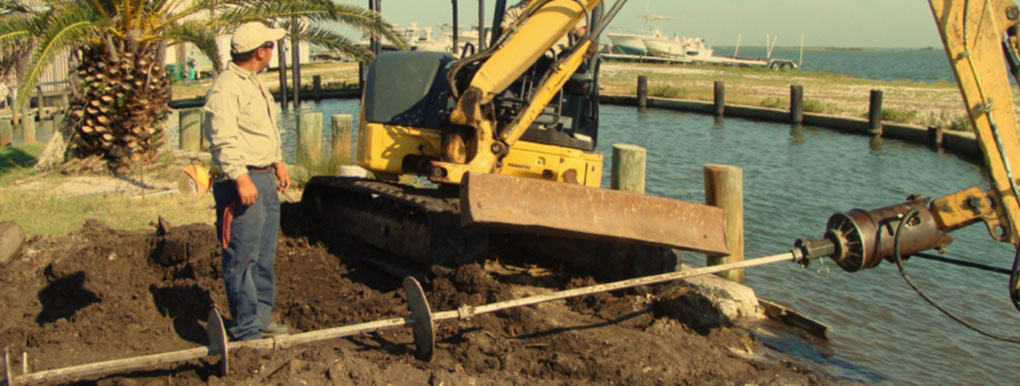
While the availability of labor popularized other foundation types for a while, the simplicity and effectiveness of screw pile techniques are once again creating demand. A screw pile consists of one or more helical plates attached to a central shaft - the helical plate being one revolution of an Archimedean screw.

In nearly every corner of the world, including the United States, screw piles were used to support shallow water and coastal lighthouses, ocean front piers, jetties, and bridges, and were also used to stabilize river banks and underpin buildings.

During this period, screw piles were fabricated from cast iron and wrought iron, both of which were in abundant supply at the time and already available in the United Kingdom and the United States. It wasn't until well after the turn of the century that steel became available. Screw pile foundations reached their maturity around 1900 and then, shortly after the turn of the century, there was a steady decline in the use of screw piles as other foundation methods became popular.

These included openhole caissons, hand-dug drilled piers, various types of driven piles, enlarged base piers and piles, and a variety of proprietary deep foundations, such as the Gow foundation, Raymond Piles, and Franki Piles. The decline in use of screw piles was also probably again related to the rise of the mechanized world of construction and the fact that installing screw piles by hand labor was superseded by machines to drive piles.

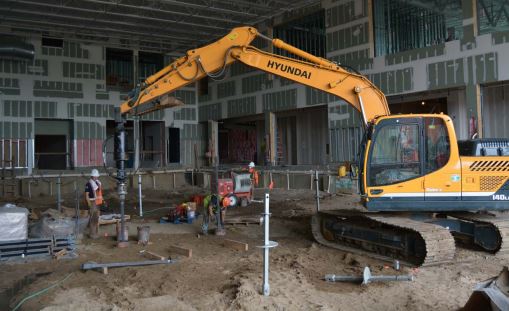
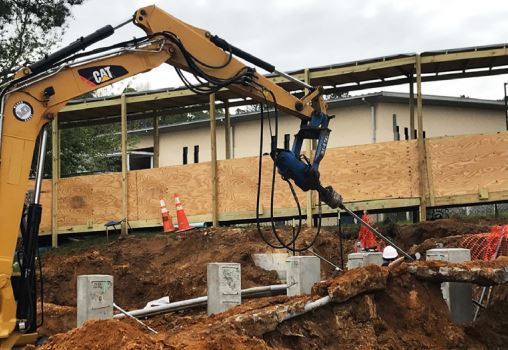
Although there are several examples of using machines to install screw piles in the late 1800s, these did not really catch on. Much of the rise of deep foundations was the result of significant developments in pile driving equipment that was becoming more readily available. However, within the last 30 years, and even more so in the last 20 years, there has been substantial and steady growth in the use of screw piles in civil construction.

Alexander Mitchell and the first screw pile Most historians agree that screw pile foundations were introduced as a full-scale practical foundation system by Alexander Mitchell (1780-1868), an Irish builder and brick manufacturer. The concept of screw piles may have come to Mitchell as early as 1831, but there is little doubt that the idea was first associated with the problem of safely mooring ships in harbors at the time and that the idea seems to have then been applied by Mitchell to solve the problem of providing good foundations for lighthouses in soft soil.

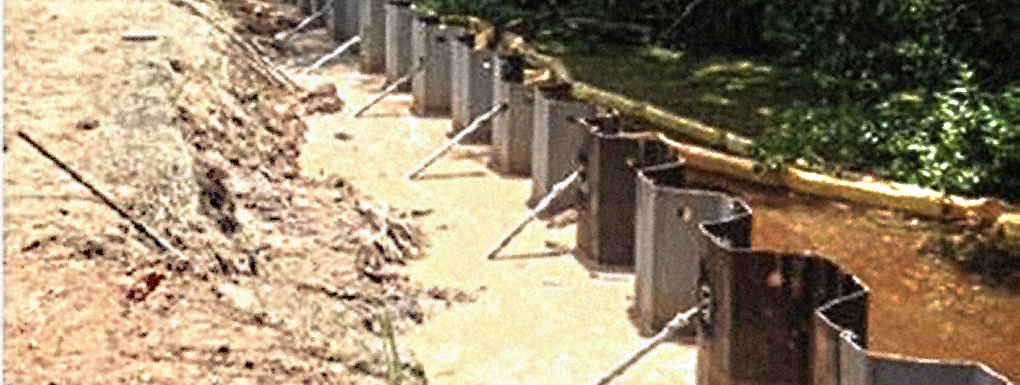
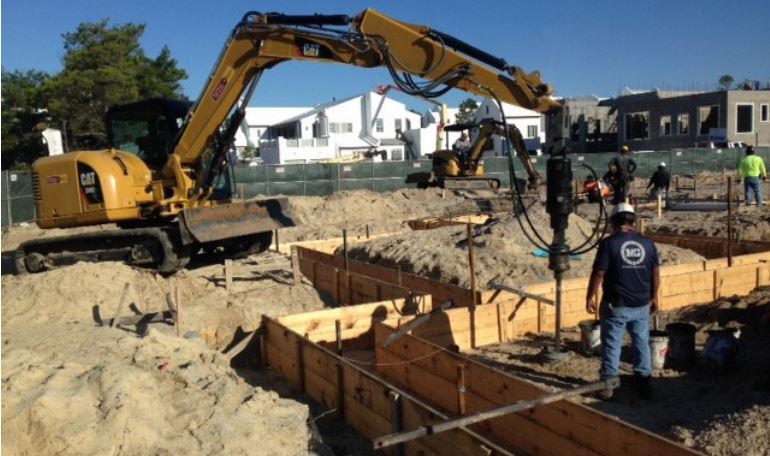
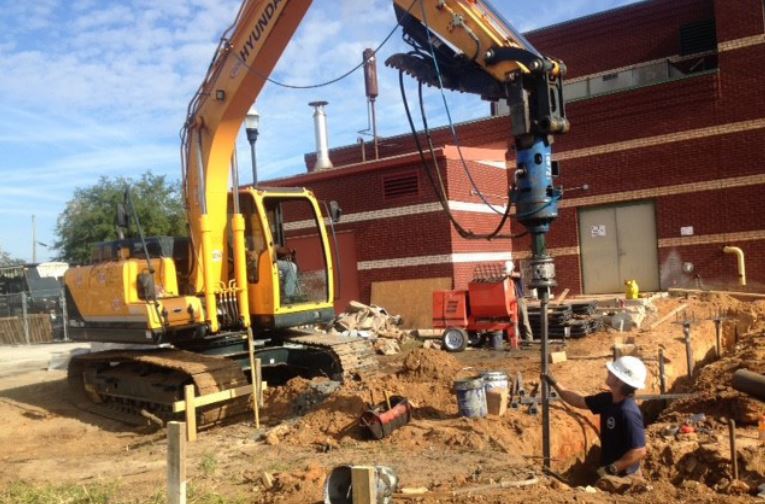
He considered the use of a single helical blade screwed into the ground for both applications. The April 1848 issue of the Civil Engineer and Architect's Journal gives a synopsis of a paper read by Mitchell at the Feb. 22, 1848, meeting of the Institution of Civil Engineers. It states that, "The origin of the screw pile was the screw mooring, which was designed for the purpose of obtaining, for an especial [sic] purpose, a greater Installation of screw piles adjacent to an existing building stabilizes the foundation. holding power than was possessed by either the ordinary pile or any of the usual mooring-anchors or blocks, of however large dimensions."

Mitchell also provided some insight into the mechanics of the bearing power of screw moorings and screw piles. "Whether this broad spiral flange, or 'ground screw,' as it may be termed, be applied to the foot of a pile to support a superincumbent weight, or be employed as a mooring to resist an upward strain, its holding power entirely depends upon the area of its disc, the nature of the ground into which it is inserted, and the depth to which it is forced beneath the surface.

The proper area of the screw should, in every case, be determined by the nature of the ground in which it is to be placed, and which must be ascertained by previous experiment." In modern geotechnical practice, the design of screw pile foundations considers all of the factors mentioned by Mitchell such as the geometry of the screw pile including size and shape of the shaft, diameter of the helix and number of helices, the depth of the installation, and the soil characteristics at the site.

Click to read more.

By Alan J. Lutenegger, a professor of Civil and Environmental Engineering at the University of Massachusetts in Amherst, Mass. lutenegg@ecs.umass.edu.

James Kempker, a territory manager with Chance Civil Construction and Hubbell Power Systems in Centralia, Mo. jhkempke@hps.hubbel.com.